How to Apply for a Senior Citizen Card: A Step-by-Step Guide (2026)
GVL Editorial
Public Services & Government Schemes Desk
Quick answer
To apply for a Senior Citizen Card, confirm you're 60 or older, then apply through your state government's citizen services portal online or at your local Tehsildar/SDM office offline. You'll need proof of age, identity, and address. Processing typically takes 7–15 days depending on your state.
60
Minimum age to apply, consistent across all states
State Social Welfare Departments, 2026
7–15 days
Typical processing time after submission
State e-District portals, 2026
28
States issuing the card through dedicated online portals
India.gov.in, 2026
What You'll Need
- Proof of age: birth certificate, PAN card, passport, or 10th-class marksheet
- Proof of identity: Aadhaar card (most widely accepted), voter ID, or driving licence
- Proof of address: utility bill, rental agreement, registered sale deed, or bank passbook
- Two passport-size photographs (for offline applications)
- A working mobile number linked to Aadhaar, if applying online
Step 1: Confirm You're Eligible
In every Indian state, you qualify for a Senior Citizen Card once you turn 60. The card itself is issued by state governments, not the central government, so the exact portal, form, and processing office differ depending on where you live — but the age threshold is consistent nationwide.
Step 2: Choose Online or Offline Application
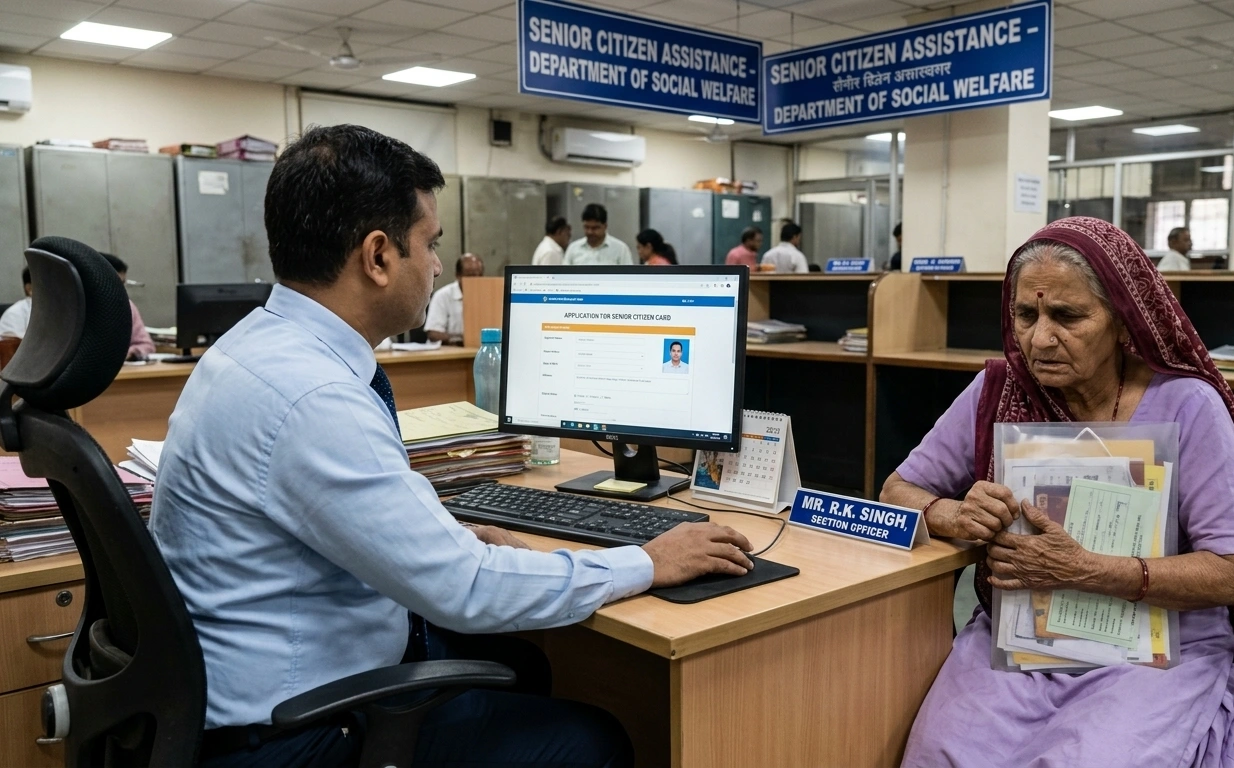
Most states now offer an online route through their e-District, social welfare, or citizen services portal. If you'd rather not apply online, every district also accepts offline applications through the local Tehsildar's office, SDM office, or nearest Common Service Centre (CSC).
Step 3: Apply Online
- Visit your state's official citizen services or social welfare portal (search "[your state] senior citizen card" to find the correct one, or start at india.gov.in and select your state)
- Register as a new user or log in with existing credentials
- Find the "Senior Citizen Card" or "Identity Card for Senior Citizens" service under the relevant department
- Fill in the application form with your personal details and upload scanned proof of age, identity, and address
- Pay the registration fee, if applicable — this varies by state and is usually a nominal amount
- Submit and note your application reference number for tracking
Step 4: Apply Offline (Alternative)
- Visit your nearest Tehsildar's office, SDM office, or Common Service Centre
- Request the Senior Citizen Card application form from the concerned official
- Fill it in and attach photocopies of your age, identity, and address proof along with photographs
- Submit the form at the counter and collect an acknowledgment slip with your reference number
Step 5: Track and Collect Your Card
Once submitted, applications are typically verified and processed within about 7–15 days, though this varies by state and current backlog. You can check status online through the same portal using your reference number, or visit the office where you applied if you went the offline route. Once approved, the card is either mailed to your registered address or available for collection in person, depending on your state's process.
Tips and Common Mistakes
- Double-check your proof-of-age document: Applications are frequently delayed because the submitted document doesn't clearly show date of birth — Aadhaar, PAN, or a birth certificate are the safest choices.
- Match your address proof to your current residence: An outdated address on your ID can cause processing delays; carry a recent utility bill if your Aadhaar address is old.
- Keep your reference number safe: You'll need it to track your application status and to follow up if there's a delay.
- Don't skip nomination fields if offered: Some state portals let you link the card to other services (like transport concessions) during application — filling these in saves a second trip later.
- Apply well before you need it: If you're applying specifically to use a travel concession or hospital priority benefit soon, allow at least 2–3 weeks of buffer for processing.
Disclaimer: This article is for informational purposes only. Scheme eligibility, benefits, and procedures may change over time. Please verify the latest information with the relevant government department or the official organization before making any decisions. This content does not constitute legal, medical, financial, or professional advice.
What changed in 2026
Most state governments have continued shifting Senior Citizen Card applications onto unified e-District and citizen services portals through 2025–2026, reducing the need for in-person visits in many states, though offline applications remain available everywhere.
Frequently asked questions
QHow long does it take to get a Senior Citizen Card?
Processing typically takes 7 to 15 days after submission, though this varies by state and current application backlog. Applying online tends to move faster in states with a well-established e-District portal, since verification is done digitally rather than manually at a counter.
QDo I need Aadhaar to apply for a Senior Citizen Card?
Aadhaar is the most widely accepted document for both identity and age proof, and it's required for most online applications since verification is Aadhaar-linked. If you don't have Aadhaar, most states accept alternatives like a passport, voter ID, or birth certificate for offline applications.
QWhat if my application gets rejected or delayed?
Most rejections happen due to unclear or mismatched documents, especially proof of age. Visit the office where you applied (or use your portal's helpdesk) with your reference number, and resubmit corrected documents. You can generally reapply without restarting the entire process from scratch.
QIs there a fee to apply for a Senior Citizen Card?
Some states charge a small registration fee, typically a nominal amount, while others issue the card free of charge. The exact fee, if any, is shown on your state's application portal or at the local office before you submit your form.
QIs the Senior Citizen Card valid across all of India?
Yes, once issued, the card is generally recognized nationwide for benefits like travel concessions and priority services, even though it's issued by your state government. Some state-specific benefits, however, may only apply within the issuing state.
GVL Editorial
Public Services & Government Schemes Desk
LunaRoot's Editorial team compiles verified, up-to-date guidance on government schemes and public services, cross-checked against official state portals and updated as processes change.